Statewide pay Government data
Sheet metal workers in North Carolina earn a statewide median of $50,730 a year, 17% below the typical U.S. metro, ranking #40 of 50 states. About 2,780 people work in the trade statewide.
Statewide pay range
States ranked near North Carolina
See all states on the sheet metal worker overview.
Pay by city Government data
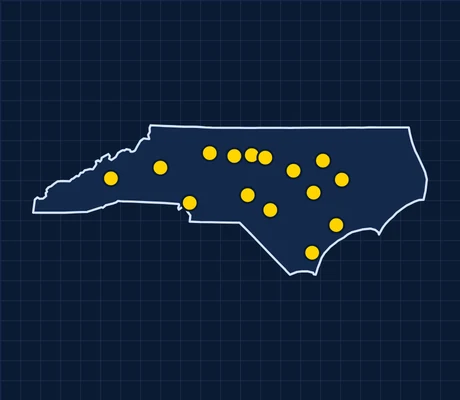
BLS publishes sheet metal worker pay for 11 North Carolina metros. The highest-paying is Greensboro at $55,860, followed by Asheville and Charlotte.
| Metro | Median pay | Real pay | Jobs |
|---|---|---|---|
| GreensboroNORTH CAROLINA · NC | $55,860 | $60,152 | 380 |
| AshevilleNORTH CAROLINA · NC | $51,790 | $53,665 | 110 |
| CharlotteNORTH CAROLINA · NC | $50,890 | $52,276 | 700 |
| JacksonvilleNORTH CAROLINA · NC | $50,680 | $55,036 | 40 |
| RaleighNORTH CAROLINA · NC | $50,570 | $51,520 | 470 |
| WilmingtonNORTH CAROLINA · NC | $47,390 | $49,149 | 90 |
| WinstonNORTH CAROLINA · NC | $47,080 | $51,150 | 170 |
| BurlingtonNORTH CAROLINA · NC | $47,020 | $50,453 | 50 |
| HickoryNORTH CAROLINA · NC | $46,800 | $52,890 | 70 |
| DurhamNORTH CAROLINA · NC | $46,240 | $47,391 | 80 |
| FayettevilleNORTH CAROLINA · NC | $46,010 | $50,023 | 70 |
Pay: BLS OEWS, May 2025 (metro-level). Real pay: BEA price parities, 2024. How we calculate
Pay outside the cities Government data
BLS also reports pay for North Carolina's rural (nonmetropolitan) regions.
BLS OEWS nonmetropolitan areas, May 2025.
The job (national)

Fabricate, assemble, install, and repair sheet metal products and equipment, such as ducts, control boxes, drainpipes, and furnace casings. Work may involve any of the following: setting up and operating fabricating machines to cut, bend, and straighten sheet metal; shaping metal over anvils, blocks, or forms using hammer; operating soldering and welding equipment to join sheet metal parts; or inspecting, assembling, and smoothing seams and joints of burred surfaces. Includes sheet metal duct installers who install prefabricated sheet metal ducts used for heating, air conditioning, or other purposes.
Nationally, jobs are projected to grow 2.5% from 2025 to 2035, with about 9,800 openings a year. Typical training: apprenticeship.
Nationally, sheet metal workers have 163 injuries or illnesses serious enough to miss work per 10,000 full-time workers, 1.9× the rate for all jobs (87). The most common cause is falls, slips and trips.
What the work is like Government data
How often sheet metal workers deal with each condition, from surveys of workers in the job.
Getting started usually takes some preparation (high school plus months of training).
O*NET 31.0 Work Context and Job Zones (U.S. Department of Labor), national.
Getting started: registered apprenticeship Government data
Most sheet metal workers train through a paid apprenticeship: you work and earn under experienced pros while taking classes, and pay usually rises as you progress. 727,586 people were active registered apprentices nationwide in FY2026, up 87% since FY2016, and construction is the largest field with 290,043 of them (40%), according to the U.S. Department of Labor.
Search apprenticeship openings ↗Find training programs & sponsors ↗
Official U.S. Department of Labor tools at Apprenticeship.gov. Counts: DOL Apprentices by State dashboard, FY2026 (all occupations).
Registered apprenticeships Government data
Of sheet metal worker apprentices in North Carolina who finished or left a registered program in fiscal years 2020–2024, 50% completed (U.S.: 57%), about 12 graduates a year. The typical program runs 8,000 hours, about 4 years of full-time work. Search open registered programs near you on the official Apprenticeship Finder.
U.S. Department of Labor, RAPIDS apprentice records (Completion Rate Analysis), FY2020–2024 exits.
Serious injuries & deaths reported to OSHA Government data
North Carolina runs its own workplace-safety program (an OSHA State Plan), so its injury reports aren't in the federal dataset. Nationally, in states federal OSHA covers, sheet metal and HVAC contractors filed 1,305 severe injury reports from 2015 to 2024; the most common cause was falls, slips and trips (46%). OSHA also opened 6 fatality investigations at sheet metal and HVAC contractors in North Carolina over the same years (federal and state programs).
OSHA Severe Injury Reports, January 2015–December 2024 (states under federal OSHA only).
Fatality investigations: OSHA Fatality Inspection Data, events 2015–2024, all states.
Where to train in North Carolina Government data
61 schools in North Carolina offer precision metal working (welding, machining, sheet metal) programs below the bachelor's level, 57 of them at public colleges. Many people in this trade learn through an apprenticeship instead; a program can shorten it or get you hired as a helper.
Where published, graduates earned a median of $39,883 in their first year out.
| School | Credential | Yearly cost | Recent grads | First-year pay |
|---|---|---|---|---|
| Central Piedmont Community College Charlotte, NC · Public | Certificate | $11,351 | 277 | — |
| Pitt Community College Winterville, NC · Public | Certificate | $15,930 | 175 | — |
| Wayne Community College Goldsboro, NC · Public | Certificate | $9,197 | 166 | — |
| Universal Technical Institute-Mooresville Mooresville, NC · Private for-profit | Certificate | $33,267 | 153 | $45,023 |
| Rowan-Cabarrus Community College Salisbury, NC · Public | Certificate | $21,028 | 142 | — |
| Wake Technical Community College Raleigh, NC · Public | Certificate | $12,665 | 122 | — |
| Fayetteville Technical Community College Fayetteville, NC · Public | Certificate | $11,235 | 119 | — |
| College of the Albemarle Elizabeth City, NC · Public | Certificate | $9,655 | 114 | — |
U.S. Department of Education College Scorecard (data updated October 2026). Cost is the school's average yearly cost of attendance before financial aid; earnings are the median for graduates one year after finishing, shown only where the school has enough graduates to publish. “—” means not published.
Licensing in North Carolina Official source
The main state licensing office in North Carolina is the North Carolina Licensing Board for General Contractors. Electrical and plumbing/HVAC have their own state boards. It can point you to the right license for sheet metal workers.
Official North Carolina licensing site ↗
Requirements for sheet metal workers vary by state and sometimes by city; always confirm with the official agency.
Union membership
In 2025, 2.5% of wage and salary workers in North Carolina were union members, below the U.S. rate of about 10% (#50 of 51 states and D.C.), and 3.1% were covered by a union contract. These figures cover all jobs in the state, not only sheet metal workers.
BLS Union Members, 2025 (Current Population Survey), table 5.
Cities in North Carolina
All trades in North Carolina.