Statewide pay Government data
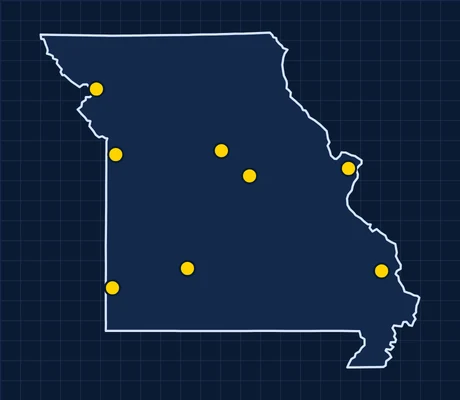
Machinists in Missouri earn a statewide median of $58,710 a year, 3% above the typical U.S. metro, ranking #28 of 50 states and DC. About 8,380 people work in the trade statewide.
Statewide pay range
States ranked near Missouri
See all states on the machinists nationwide.
Pay by city Government data
BLS publishes machinist pay for 8 Missouri metros. The highest-paying is St. Joseph at $66,390, followed by St. Louis and Kansas City.
| Metro | Median pay | Real pay | Jobs |
|---|---|---|---|
| St. JosephMISSOURI · MO | $66,390 | $76,856 | 80 |
| St. LouisMISSOURI · MO | $62,210 | $65,424 | 5,620 |
| Kansas CityMISSOURI · MO | $56,740 | $61,312 | 1,350 |
| Jefferson CityMISSOURI · MO | $51,850 | $58,937 | 70 |
| SpringfieldMISSOURI · MO | $51,100 | $57,685 | 410 |
| ColumbiaMISSOURI · MO | $50,120 | $56,039 | 240 |
| Cape GirardeauMISSOURI · MO | $48,160 | $55,949 | 100 |
| JoplinMISSOURI · MO | $46,820 | $54,621 | 360 |
Pay: BLS OEWS, May 2025 (metro-level). Real pay: BEA price parities, 2024. How we calculate
Pay outside the cities Government data
BLS also reports pay for Missouri's rural (nonmetropolitan) regions.
BLS OEWS nonmetropolitan areas, May 2025.
The job (national)

Set up and operate a variety of machine tools to produce precision parts and instruments out of metal. Includes precision instrument makers who fabricate, modify, or repair mechanical instruments. May also fabricate and modify parts to make or repair machine tools or maintain industrial machines, applying knowledge of mechanics, mathematics, metal properties, layout, and machining procedures.
Nationally, jobs are projected to grow 1.0% from 2025 to 2035, with about 26,100 openings a year. Typical training: long-term on-the-job training.
Nationally, machinists have 108 injuries or illnesses serious enough to miss work per 10,000 full-time workers, 1.3× the rate for all jobs (87). The most common cause is being struck by or caught in objects and equipment.
What the work is like Government data
How often machinists deal with each condition, from surveys of workers in the job.
Getting started usually takes medium preparation (vocational training or an apprenticeship, often 1–2+ years).
O*NET 31.0 Work Context and Job Zones (U.S. Department of Labor), national.
Registered apprenticeships Government data
Of machinist apprentices in Missouri who finished or left a registered program in fiscal years 2020–2024, 55% completed (U.S.: 61%), about 16 graduates a year. The typical program runs 5,600 hours, about 3 years of full-time work. Search open registered programs near you on the official Apprenticeship Finder.
U.S. Department of Labor, RAPIDS apprentice records (Completion Rate Analysis), FY2020–2024 exits.
Serious injuries & deaths reported to OSHA Government data
From 2015 to 2024, machine shops in Missouri filed 21 severe injury reports (a hospital stay, amputation or loss of an eye), 11 of them involving an amputation. The most common cause was contact with objects and equipment (76% of reports). These cover everyone at those employers, not only machinists.
OSHA Severe Injury Reports, January 2015–December 2024 (states under federal OSHA only).
Where to train in Missouri Government data
19 schools in Missouri offer precision metal working (welding, machining, sheet metal) programs below the bachelor's level, 17 of them at public colleges. Many people in this trade learn through an apprenticeship instead; a program can shorten it or get you hired as a helper.
Where published, graduates earned a median of $47,133 in their first year out.
| School | Credential | Yearly cost | Recent grads | First-year pay |
|---|---|---|---|---|
| Metropolitan Community College-Kansas City Kansas City, MO · Public | Certificate | $16,722 | 131 | — |
| Midwest Technical Institute-Missouri Springfield, MO · Private for-profit | Certificate | $28,735 | 73 | $40,580 |
| State Technical College of Missouri Linn, MO · Public | Associate degree | $20,731 | 57 | $52,814 |
| Ozarks Technical Community College Springfield, MO · Public | Certificate | $21,074 | 56 | $31,994 |
| Ranken Technical College Saint Louis, MO · Private nonprofit | Certificate | $30,904 | 54 | $51,970 |
| East Central College Union, MO · Public | Certificate | $20,184 | 44 | $42,296 |
| State Fair Community College Sedalia, MO · Public | Certificate | $15,002 | 36 | — |
| Crowder College Neosho, MO · Public | Certificate | $16,292 | 28 | — |
U.S. Department of Education College Scorecard (data updated October 2026). Cost is the school's average yearly cost of attendance before financial aid; earnings are the median for graduates one year after finishing, shown only where the school has enough graduates to publish. “—” means not published.
Licensing in Missouri Official source
Missouri licenses most trades at the city or county level. Check with the building or licensing office where you plan to work.
Requirements for machinists vary by state and sometimes by city; always confirm with the official agency.
Union membership
In 2025, 9.8% of wage and salary workers in Missouri were union members, close to the U.S. rate of about 10% (#22 of 51 states and D.C.), and 11.2% were covered by a union contract. These figures cover all jobs in the state, not only machinists.
BLS Union Members, 2025 (Current Population Survey), table 5.
Cities in Missouri
All trades in Missouri.